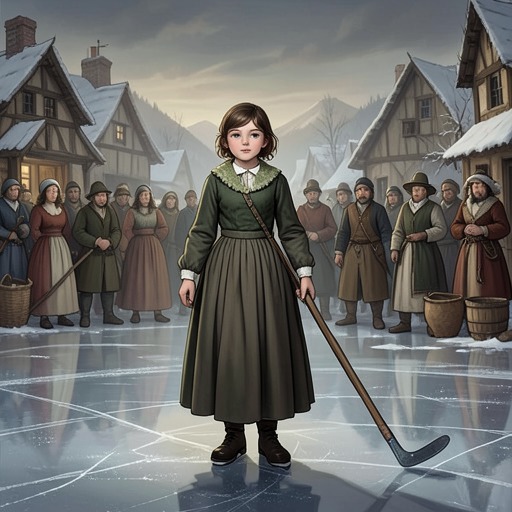
Rychie Korbes—Gretel Brinker
Hans Brinker, or The Silver SkatesRychie Korbes—Gretel Brinker is a relationship marked by class prejudice rather than mutual intimacy: Rychie treats Gretel’s poverty as a reason to deny her equal standing, and objects when the peasant girl is allowed to enter the skating race. The contrast between Rychie’s social power and Gretel’s vulnerability makes the race more than a contest; it becomes a test of who is entitled to take part alongside whom.
The Class Boundary Rychie Enforces
Rychie is described as beautiful and socially accomplished, but inwardly clouded by pride, discontent, and envy. The narrator presents her contempt for Gretel as part of a larger conviction about social rank. To Rychie, a poor peasant girl is not a fellow human being, a creature made by God like herself, but a sign of “poverty, rags, and dirt.” The contrast is not simply between two girls with different means: Rychie’s way of seeing turns Gretel’s circumstances into her whole identity.
That view carries a rule about where people of Gretel’s class may appear. Rychie thinks the poor may toil for their social superiors at a respectful distance and may admire them humbly, but should not cross their paths in a way that displeases them. If they resist, she believes they should be put down; if they suffer, their distress is not her concern. The narrator calls this her secret motto, exposing how the polished surface of a well-bred girl can coexist with a harsh refusal of compassion. Rychie’s hostility toward Gretel is thus presented not as a single irritation but as an expression of a hierarchy she considers natural.
The Race as a Public Test
The skating race on the twentieth gives that hierarchy a specific point of conflict. When Gretel is permitted to join, Rychie declares that it is “Disgraceful, shameful, too bad!” She and Katrinka Flack oppose the idea that a goose-girl, whom Rychie calls a forlorn little creature, should be allowed to spoil the race. Rychie’s objection makes participation itself seem like an offense: Gretel is not accused of a particular failing on the ice; her supposed unfitness comes from her poverty and social position.
The narrator distinguishes Rychie’s anger from Katrinka’s easy echo. Katrinka agrees with Rychie in this instance, but the account suggests she might just as readily have agreed to Gretel’s inclusion if Hilda van Gleck had first spoken to her. Rychie, by contrast, is presented as the girl whose judgment sets the exclusionary tone. Her own words give the dispute its force, and Katrinka’s imitation shows how that force can gather support beyond Rychie herself.
Influence and Social Power
Rychie has followers besides Katrinka. The narrator says that, rich and powerful in the limited world of schoolgirls, she draws other girls into sharing her opinions because they are too careless or too cowardly to think for themselves. Her position therefore matters beyond her personal view of Gretel: it helps turn prejudice into a group judgment. The race becomes a setting in which social approval can be used to reinforce the boundary Rychie wants to maintain.
Her influence is sharpened by the contrast between public charm and private conviction. Rychie dresses tastefully, sings charmingly, and can display feeling for pet kittens and rabbits. She also bewitches honest-minded boys such as Lambert van Mounen and Ludwig van Holp. Those accomplishments make her socially attractive, but they do not soften her treatment of Gretel. The contrast underscores the limits of a cultivated manner: tenderness toward favored animals and charm toward admirers do not amount to recognition of a poor girl’s dignity.
Gretel’s Circumstances and the Limits of the Relationship
The available account chiefly shows Rychie judging Gretel; it does not describe an intimate friendship, a direct exchange between them, or Gretel’s response to Rychie’s words. Gretel’s circumstances nevertheless make the class division concrete. While the race is being discussed, Raff Brinker lies moaning on a rough bed, and Gretel works to help her exhausted mother: she wipes the brick floor, brings peat for the fire, melts ice, and prepares a willow bed so her mother can rest. The household’s hardship is not an abstraction, yet Rychie reduces the girl living through it to poverty and dirt.
The relation is therefore asymmetrical in both social position and narrative attention. Rychie speaks and recruits agreement; Gretel is the person being spoken about and excluded. By placing Rychie’s insistence on rank beside the work and care demanded of Gretel at home, the narrative reveals what that insistence refuses to see: a person whose poverty does not erase her humanity. The race exposes Rychie’s prejudice in action, while the account of Gretel’s labor supplies the human reality obscured by her class label.